Linux Lab
The Linux Lab in SIC 206 is the department's home base, where students take their programming courses and work together outside class.
Edit me
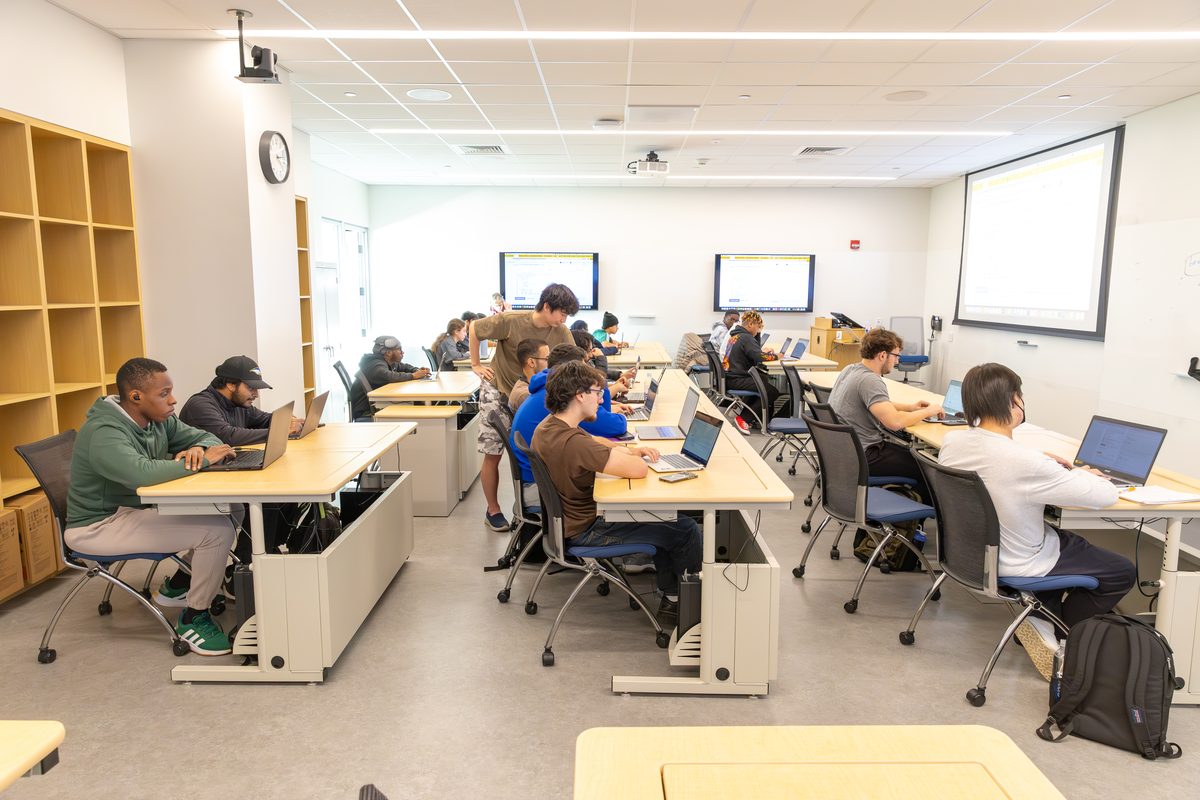
The Linux Laboratory (Linux Lab), in room 206 of the Science and Innovation Center, is the home base of the Computer Science department. It’s where majors and minors take their programming classes in their first two years and beyond, and where students come to work and collaborate outside class. It’s built for learning to program, with 40 Linux workstations running the same professional tools that software developers use every day.
Courses
The Linux Lab supports the computer science fundamentals and is used extensively for programming, networking and systems courses:
- The lab sections of the introductory programming sequence meet here: CSC 15 (Python), CSC 16 (C++) and CSC 17 (Java).
- Upper-level courses also use the lab, including Programming Languages, Operating Systems, Advanced Algorithms and Data Structures, and systems and networking courses.
- In CSC 110, students program in C and x86 assembly with the GNU tools on the department’s Linux workstations.
Specifications
Every seat has its own Linux workstation, so students work on the same kind of system that powers much of the world’s servers and cloud computing.
- Workstations: 40 student workstations and an instructor workstation, all Lenovo ThinkStation desktops with Intel Core i7 processors, 32 GB of memory and 1 TB solid-state drives.
- Displays: 22-inch Lenovo ThinkVision monitors; the instructor station has an interactive pen display.
- Operating system: Rocky Linux, a Red Hat Enterprise Linux compatible distribution. Every department Linux workstation is set up with the same software, so students find the same tools at any seat. The student workstations run Linux only; the instructor workstation also runs Windows.
- Software includes the GNU toolchain, the Java JDK, Visual Studio Code, NetBeans, Eclipse, Qt Creator, Python 3 with IDLE and Anaconda, VirtualBox, TeX Live, LibreOffice, Inkscape, GIMP, Dia, FileZilla, Google Chrome and Firefox.
Access & Help
- Accounts: Students in Computer Science courses receive a Computer Science Linux account that works on any department Linux workstation.
- Getting in: The lab has a card reader, and students registered for a class that meets in the lab receive card access for that semester. When no class is scheduled, the lab is open to CS students (the building and labs are normally open 7 AM to 9 PM, Monday through Friday).
- Remote access: You can log in to the Linux workstations remotely with SSH, which is built into Windows, macOS and Linux. PuTTY, Cygwin and MobaXterm also work, and Visual Studio Code can connect with its Remote - SSH extension. The SSH guide has the directions, and Remote Access to Labs has more options.
- Tutoring: Tutoring for Computer Science courses is in SIC 226.