Big Data Lab
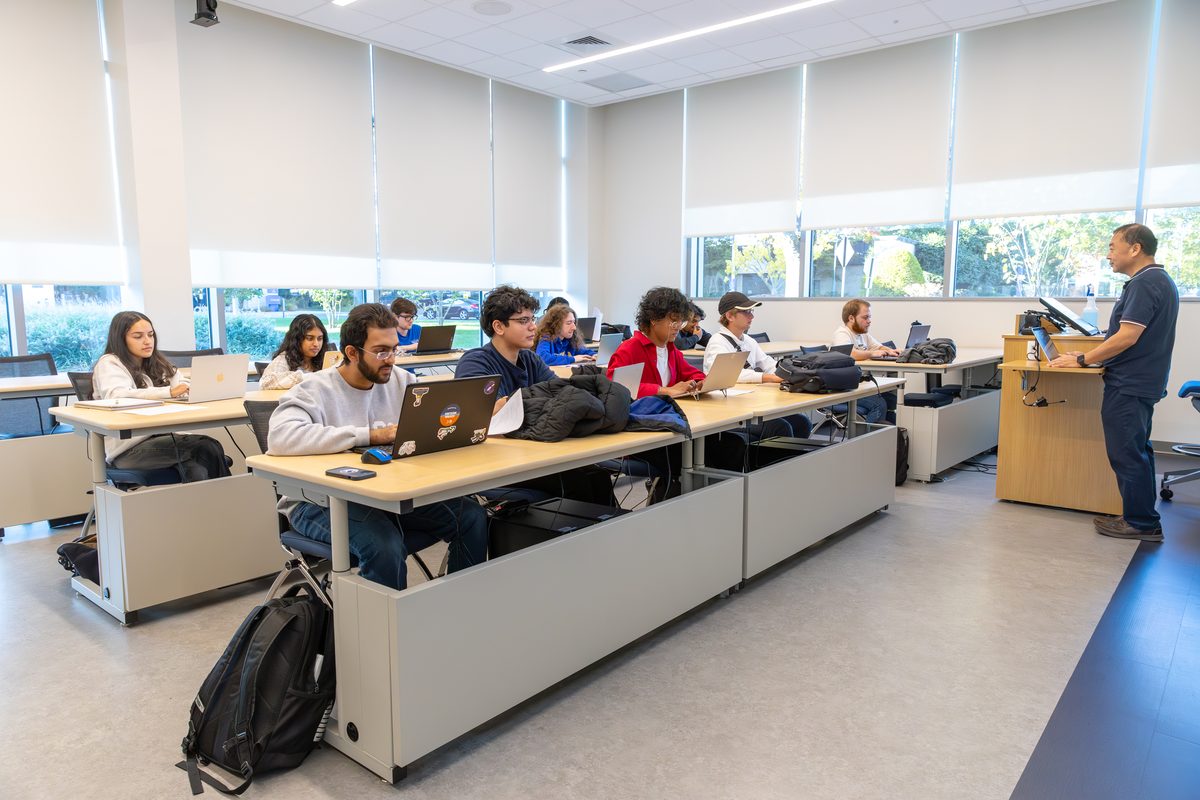
The Big Data Lab, in room 126 of the Science and Innovation Center, gives students a comprehensive education in large-scale and distributed information systems, preparing them for highly skilled roles in fast-growing fields such as cloud computing, healthcare informatics, finance, data integration and data analytics. Every student works at a powerful Linux workstation with its own graphics processor (GPU), the kind of hardware that makes machine learning practical.
Courses & Faculty
The lab’s focus areas are system development, testing, maintenance, data security and privacy, data integration, networking, cybersecurity and application development, along with machine learning, artificial intelligence, text mining and natural language processing.
Courses that use the lab include:
- CSC 111 Assembly-Language Programming (Simon Shamoun)
- CSC 149 Introduction to Text Mining (Simona Doboli)
- CSC 156 Introduction to Machine Learning (Corey Elwosky)
- CSC 158 Introduction to Artificial Intelligence (Simona Doboli)
- CSC 175 Data Communications and Networking (Simon Shamoun)
- CSC 220 Deep Learning, a graduate course that uses both the lab’s GPU workstations and the Star HPC cluster
Faculty. Professors that use this lab include Simona Doboli, whose research covers artificial intelligence, text mining, deep learning, creativity, neural cognitive models and computational neuroscience, and Simon Shamoun, who applies theoretical computer science to computer networking, routing in ad hoc wireless networks, resource allocation in sensor networks and computer architecture.
Specifications
The lab is built for hands-on work with data, AI and networks: each workstation pairs a fast processor with a dedicated GPU, and each has extra drives so students can set up their own systems.
- Workstations: 33 student workstations and an instructor workstation of the same configuration: Lenovo ThinkStation P3 Tower desktops with an Intel Core i7-13700 processor, an NVIDIA T1000 8 GB GPU, 32 GB of memory and three 512 GB solid-state drives.
- Displays: 22-inch Full HD Lenovo ThinkVision monitors.
- Operating systems: the student workstations run Rocky Linux with the same software and CS Linux accounts as the Linux Lab. The lab is designed for three operating systems per workstation: Rocky Linux, Windows, and a third drive on which students install and configure their own operating system (usually Ubuntu) in a networking class. The instructor workstation runs Rocky Linux and Windows.
- Data Center resources: Students can reach resources hosted in the Data Center, such as their course, project and research virtual machines, directly from the lab’s workstations.
Access & Help
- Accounts: Students log in with their Computer Science department Linux accounts.
- Getting in: The lab has a card reader, and students registered for a class that meets in the lab receive card access for that semester. Outside class hours the lab is open for student work (the building and labs are normally open 7 AM to 9 PM, Monday through Friday).
- Remote access: The workstations can be reached with SSH after connecting to the department VPN. Remote Access to Labs has the details.
- Virtual machines: Virtual machines for courses, projects and research run in the Data Center. The Virtual Machine FAQ explains how to reach them.